
Understanding Wi-Fi 6E Technology and the Future of Wireless Connectivity

Wi-Fi 6, also known as IEEE 802.11ax, improved network capacity and efficiency as more devices began sharing wireless connections. Wi-Fi 6E extends those capabilities into the 6 GHz band where that spectrum is available. Wi-Fi 7 builds on both generations with wider channels and new ways to use multiple wireless links. The performance of wireless equipment also depends on its physical RF signal path. Connectors, cable assemblies and antennas must be selected for the frequencies, packaging and environmental conditions of the application.
- Wi-Fi 6 utilizes 1024 Quadrature Amplitude Modulation (QAM) alongside a 160 MHz channel to provide speeds up to 9.6 Gbps, compared to the 6.9 Gbps of the traditional 256-QAM 802.11ac
- The 1024-QAM technology allows each symbol to carry 10 bits rather than 8, a 25% improvement over traditional 802.11ac 256-QAM networks

For the consumer, this will translate to seamless streaming and utilization of internet-enabled services. Wi-Fi 6 also provides four times more capacity for devices on the network through:
- 8x8 uplink/downlink
- MU-MIMO (multi-user multiple-input multiple-output)
- OFDMA (orthogonal frequency-division multiple access)
- Basic Service Set (BSS) coloring which allows for continuous reliability in congested networks.
- Wi-Fi 6 also utilizes a 4x longer Orthogonal Frequency-Division Multiplexing (OFDM) symbol (thus creating 4x more sub-carriers) which allows for an 11% speed increase and improved network coverage.
Additionally, the 160 MHz channel width (up from 80 MHz in 802.11ac) allows for a faster connection between your device and its router. This in turn reduces the potential for lag or buffering whilst streaming.
While the previous 802.11ac channel was unable to utilize OFDMA technology, Wi-Fi 6 leverages this capability to utilize routers to transfer packets and data to multiple devices simultaneously without congestion or slowing down the overall network. This translates to faster uploads and downloads for the user. The 8x8 MU-MIMO capability of Wi-Fi 6 builds off of this by allowing connected users to leverage up to 8 upload or download streams with no noticeable decrease in the quality of bandwidth.
Market Potential and Deployment Challenges for Wi-Fi 6:
The market potential for Wi-Fi 6 is vast in regards to both geographic reach and capital gains.
- With a 2022 market size of $11.59 billion and a compound annual growth rate (CAGR) of 17.9% between 2022-2027, ultimately reaching upwards of $26.2 billion (31% of the global market revenue was accounted for by Asia Pacific in 2022).
- The main driving market force behind this growth is the increased number of internet users, which ultimately requires networks that can sustain speed and reliability despite congested environments.
- Additionally, as the overall quality of streamed media improves (such as in resolution), more will be demanded of Wi-Fi networks in regards to their ability to facilitate this

The main restraint in regards to market growth is co-channel interference and contention loss. Contention loss is the poor network performance that occurs when multiple clients join a singular access point. Co-channel interference occurs when multiple access points using the same radio frequency (RF) channel affect each other's network performance.
These issues are prevalent in regions with thoroughly developed Wi-Fi infrastructure, such as Asia Pacific, North America, and Europe. Integrating further Wi-Fi networks within these regions may exacerbate these issues and has caused concern in regards to the proliferation of new access points and the distribution of users along them.
Wi-Fi 6 versus Wi-Fi 6e, what’s the difference?:
The main difference between standard Wi-Fi 6 and Wi-Fi 6 extension (6E) is that 6E creates a proverbial “fast lane” for devices that are capable of utilizing it, which results in overall lower latency and faster speeds. Wi-Fi 6 enabled devices are able to rapidly transit data within the 6 GHz band while benefiting from the fact that the network itself isn’t cluttered by legacy devices. On the organizational level Wi-Fi 6E provides enhanced security measures that allow for secure network transmissions. The Wi-Fi Alliance has mandated that all Wi-Fi 6E devices be protected by Wi-Fi Protected Access 3 (WPA3), which ensures universal security across the access points under the classification of the network.

Applications in the Industrial Setting:
Industrial facilities may use Wi-Fi to connect maintenance tools, monitoring equipment, mobile devices and production systems. Wireless access can help personnel retrieve operational data and perform remote diagnostics without relying on a fixed connection at every location.
Wi-Fi 6 features can help when devices have different traffic needs. OFDMA improves how an access point allocates channel resources among compatible devices, while MU-MIMO can serve multiple devices through spatial streams. Beamforming helps direct radio energy toward connected devices. None of these features eliminates interference or guarantees a particular speed; their benefit depends on the equipment and network design.
What’s next for Wi-Fi?:
Wi-Fi 7, also known as 802.11be, is expected to be the next generation of Wi-Fi technology following Wi-Fi 6 (802.11ax). Its being developed with promises of major improvements over Wi-Fi 6 and 6E, offering speeds up to four times faster. It works across all three industry-standard bands (2.4 GHz, 5 GHz, and 6 GHz) to fully utilize spectrum resources. While Wi-Fi 6 was built in response to the growing number of devices in the world, Wi-Fi 7's goal is to deliver astounding speeds for every device with greater efficiency. It also includes clever advances to reduce latency, increase capacity and boost stability and efficiency.
What benefits will Wi-Fi 7 bring?:
-
Higher Data Rates: Wi-Fi 7 aims to provide even higher data rates compared to Wi-Fi 6, catering to the increasing demand for faster and more reliable wireless connections. This is achieved through advanced modulation and encoding techniques.
- Improved Spectral Efficiency: Wi-Fi 7 is designed to make more efficient use of the available radio spectrum, enabling better performance in environments with high device density.
- Enhanced MU-MIMO (Multi-User, Multiple Input, Multiple Output): MU-MIMO technology allows multiple devices to communicate with the router simultaneously, improving overall network efficiency. Wi-Fi 7 is expected to further refine and enhance this feature.
- Increased Channel Bandwidth: Wi-Fi 7 supports wider channel bandwidths, allowing for faster data transmission. With Wi-Fi 6E, they can be as wide as 160 MHz. Wi-Fi 7 supports channels that are up to 320 MHz. This could lead to improved performance, particularly in scenarios where higher data rates are crucial.
- Higher QAM: Quadrature Amplitude Modulation (QAM) is a method to transmit and receive data in radio-frequency waves. The higher it is, the more information can be included. Wi-Fi 7 supports 4K-QAM whereas Wi-Fi 6 supported 1024-QAM and Wi-Fi 5 was even further limited to 256-QAM.
- Better Reliability: The new standard is likely to include mechanisms to mitigate interference and ensure more consistent and reliable connections even in crowded wireless environments.
- Backward Compatibility: Like previous Wi-Fi standards, Wi-Fi 7 is expected to be backward compatible with older Wi-Fi devices, allowing them to connect to Wi-Fi 7 routers, albeit at lower speeds.
- Security Enhancements: Wi-Fi 7 is likely to include updated security features to address evolving cybersecurity threats and vulnerabilities.
- IoT and Smart Device Support: Wi-Fi 7 is expected to provide improved support for the growing number of Internet of Things (IoT) devices, which often have unique connectivity requirements.
- Energy Efficiency: While not as pronounced as in cellular technologies, Wi-Fi 7 might introduce energy-saving features to extend device battery life in certain scenarios.
What’s different from the previous generations?
| Wi-Fi 6 | Wi-Fi 6E | Wi-Fi 7 | |
| Launch date | 2019 | 2021 | 2024(expected) |
| IEEE standard | 802.11ax | 802.11ax | 802.11be |
| Max data rate | 9.6 Gbps | 9.6 Gbps | 46 Gbps |
| Bands | 2.4Ghz, 5Ghz | 2.4 GHz, 5 GHz, 6 GHz | 2.4 GHz, 5 GHz, 6 GHz |
| Channel Size | 20, 40. 80, 80+80, 160MHz | 20, 40, 80, 80+80, 160 MHz | Up to 320 MHz |
| Modulation | 1024-QAM OFDMA | 1024-QAM OFDMA | 4096-QAM OFDMA |
| MAC | / | / | MLO |
MLO technology:
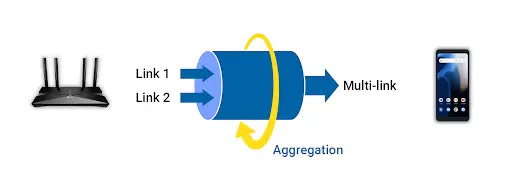
Wi-Fi 7 will introduce Multi-Link Operation (MLO) technology which allows devices to simultaneously send and receive data over multiple radio bands to create a single aggregated connection. This provides faster throughput performance.
Market potential for Wi-Fi 7:
-
The Wi-Fi 7 Market is estimated at USD 1.0 billion in 2023 and is projected to reach USD 24.2 billion by 2030, at a CAGR of 57.2% from 2023-2030.
- The rising adoption of the Internet of Things (IoT) is the main driver for the market growth.
- North America is expected to hold the highest growth rate during the forecast period.
- High costs of installation and the spectrum congestion present a significant challenge for the Wi-Fi 7 market.
Applications in different industries:
- Media and Entertainment
- Business
- Smart Home
- Smart City
- Healthcare
- Public Safety
- Educational Institutions
Recent developments:
-
In December 2022. Rohde & Schwarz and Broadcom collaborated to announce the availability of an automated test solution for Broadcom Wi-Fi 7 chipsets.
- In January 2023. MediaTek introduced Consumer-Ready Wi-Fi 7 products in product categories, including residential gateways, mesh routers, televisions, streaming devices, and more at CES 2023.
- In March 2023, Lounea partnered with TP-Link to become Finland’s first Wi-Fi 7 operator to offer Wi-Fi 7 standards for home wireless networks.
Related Amphenol Products:
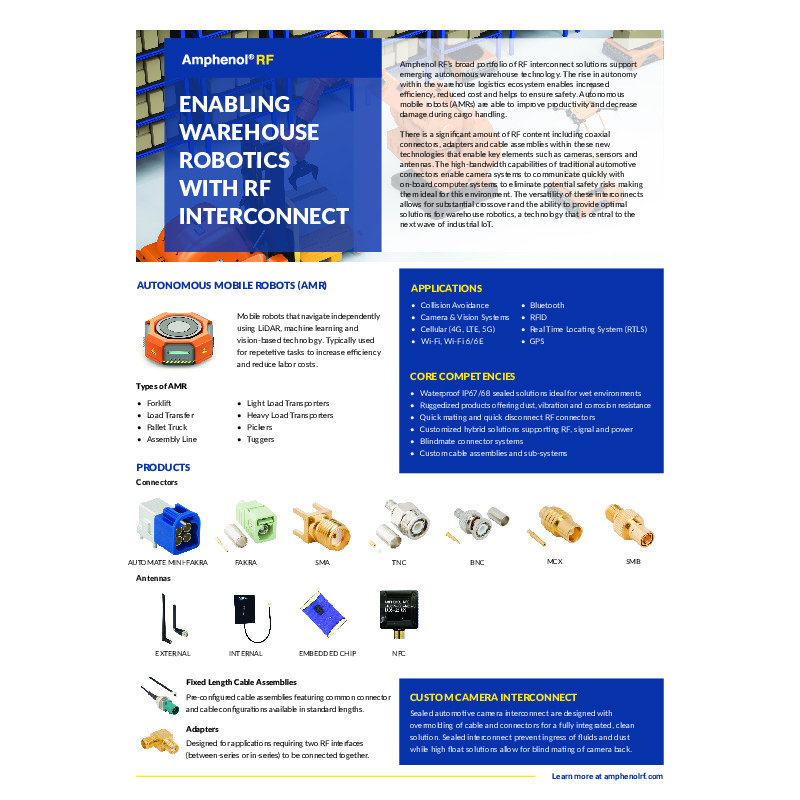
Amphenol RF has developed a number of high-bandwidth interfaces capable of data transfer rates fast enough to handle the next generation of Wi-Fi. New Wi-Fi technology requires connectors and cable assemblies that can carry more data, faster and in a smaller size.
The 2.2-5 and 4.3-10 interfaces are ideal for Wi-Fi applications in the sense that they are lightweight, robust connectors in a smaller design. The legacy 7-16 connector, which is particularly reliable and weather resistant, is the perfect solution designed for wireless infrastructure applications that require durability to withstand harsh environments. TNC, which is available in IP67 waterproof versions, also support the next generation Wi-Fi with better reliability.
There are also specific products such as HD-EFI and HD-AFI, which are ultra-compact interface designs. Despite their smaller size, these products can support Wi-Fi applications for consistent and reliable connectivity, even in crowded environments.
Lastly, Amphenol RF’s high-performance series SMA, SMP, and SMPM supports wider channel bandwidths, allowing for higher data transmission.
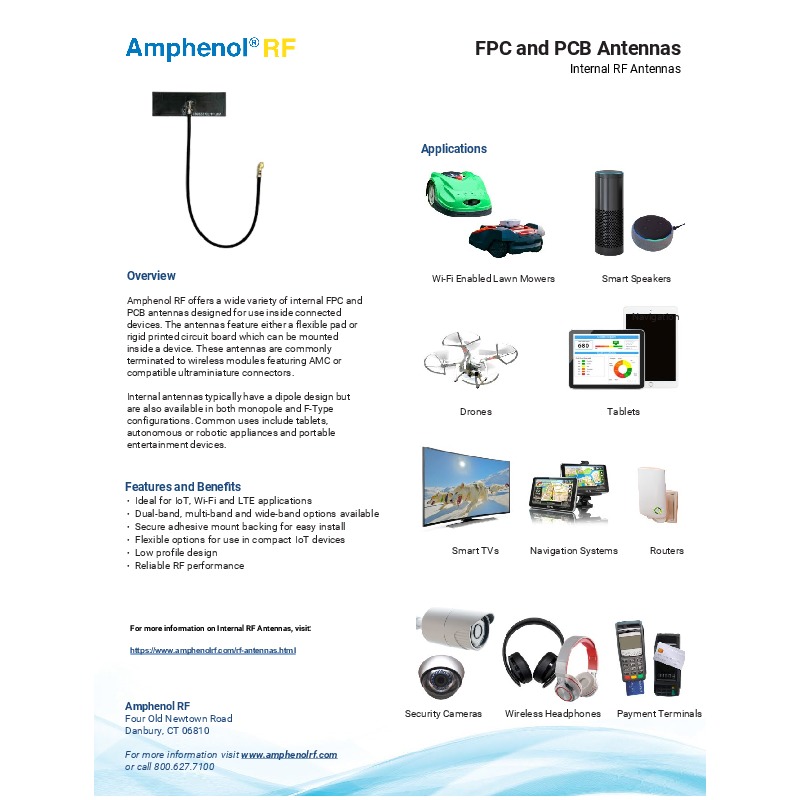
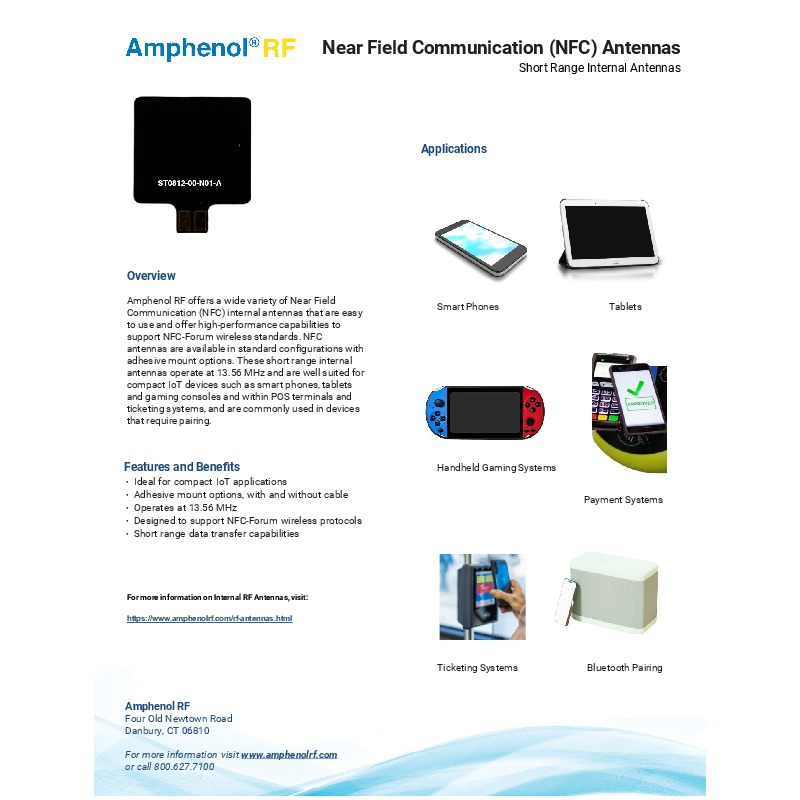
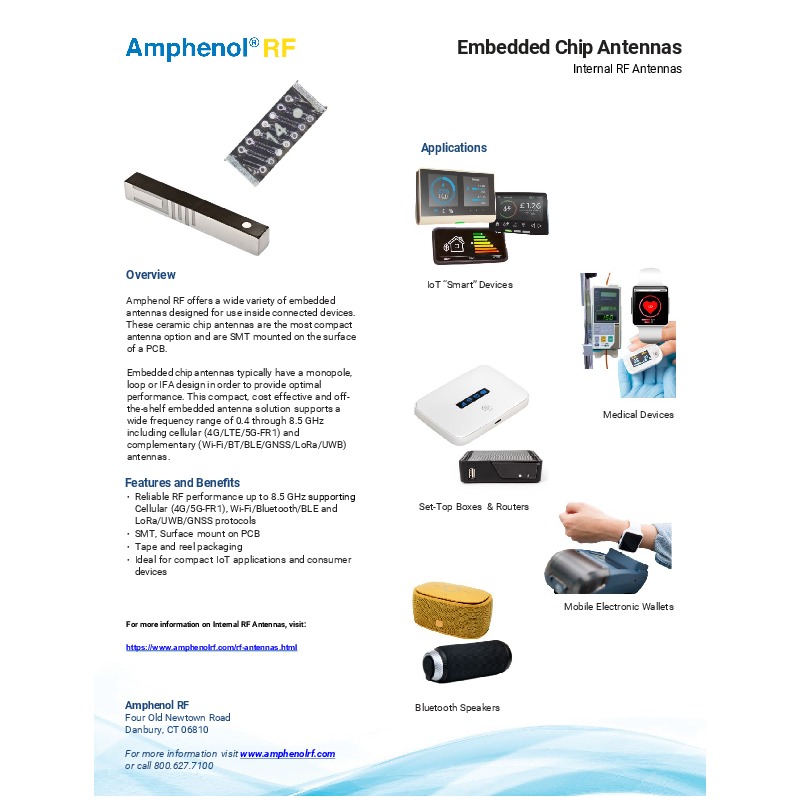
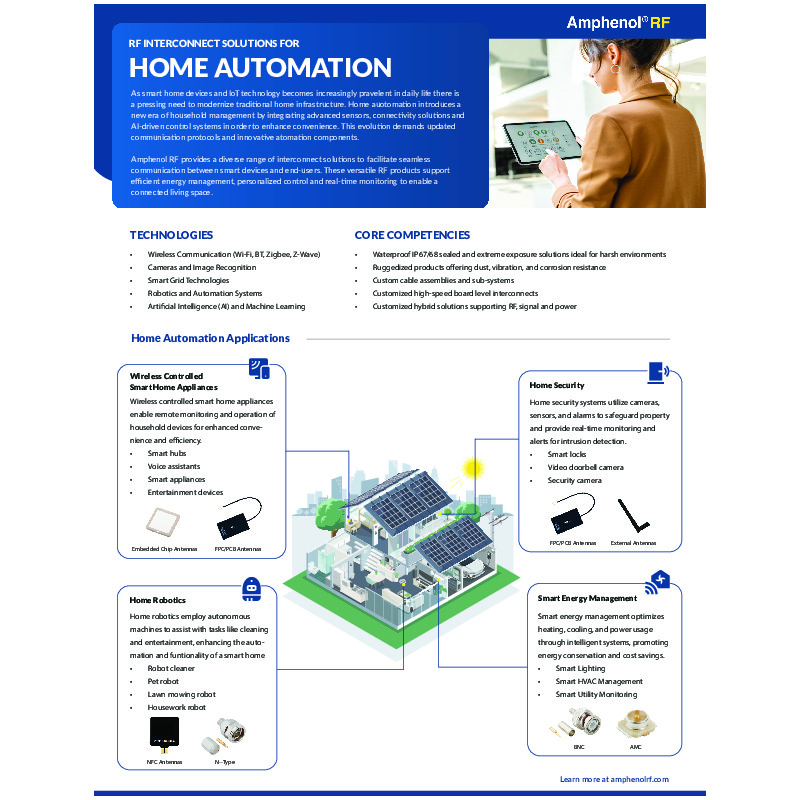
For a complete solution, RF antennas designed for IoT devices such as smart phones and tablets are available in a variety of external and internal configurations including embedded chip and PCB versions.
Ressources connexes








Envoyez-nous un message
Veuillez remplir le formulaire ci-dessous ; nous vous contacterons très prochainement.
Les champs marqués d'un astérisque (*) sont obligatoires.