
RF Connectivity for Robotics: 6 Robotics Trends Driving the Future of RF Connectivity

RF Connectivity for Robotics: 6 Robotics Trends Driving the Future of RF Connectivity
Robotics is rapidly becoming more intelligent, autonomous and connected. Across factories, warehouses and other industrial environments, robots are using artificial intelligence, advanced sensors and high-speed wireless networks to make decisions, navigate surroundings and coordinate with other systems in real time. Behind these capabilities is an increasingly complex RF architecture.
Cameras, LiDAR, radar, antennas, sensors, processors and wireless modules all depend on reliable connections to transmit critical data. As robotic platforms become smaller and more sophisticated, engineers must support higher data rates, lower latency and greater connector density while accounting for vibration, continuous movement and demanding operating environments. The challenge is no longer simply connecting components. It is creating an RF connectivity infrastructure capable of supporting the next generation of robotics.
Amphenol RF provides radio frequency connectors, adapters and coaxial cable assemblies designed to support these evolving requirements across industrial robotics and connected automation systems. The company's robotics portfolio includes compact, high-performance solutions for cameras, sensors, antennas and embedded electronics.
Explore Amphenol RF solutions for robotics
1. AI-Driven Autonomous Robots Require Reliable Real-Time Connectivity
One of the most significant robotics trends is the transition from programmed automation to AI-driven autonomous robots. Autonomous mobile robots, collaborative robots, drones and emerging humanoid robots are increasingly able to interpret their surroundings, make decisions and adapt their behavior without continuous human direction. This intelligence depends on constant communication between cameras, sensors, navigation systems, antennas and onboard processors.
The RF connectivity challenge
Autonomous robots generate large quantities of data that must move quickly between sensing and processing systems. Signal degradation or intermittent connections can affect a robot's ability to interpret its surroundings and respond accurately. Mobility makes this challenge more difficult. Connections inside robotic systems may be exposed to vibration, continuous movement, mechanical shock and repeated operating cycles.
Amphenol RF offers several RF connector families that can support autonomous robotic architectures.

2. Private 5G and Advanced Wireless Networks Are Connecting the Factory Floor
Industrial robotics is increasingly part of a larger connected automation environment. Private 5G, Wi-Fi and other advanced wireless networks allow robots, sensors, manufacturing equipment and control systems to exchange information throughout a facility. Private networks can be particularly valuable for applications that require high bandwidth, predictable communications and low latency. As more machines become connected, RF infrastructure must support communication not only inside the robot but also between robots and the surrounding network.
The RF connectivity challenge
A mobile robot cannot rely on a connection that works only in one section of a facility. Wireless performance must remain dependable as robots move between work cells, storage areas, loading zones and network access points. Increasing numbers of connected devices can also create more challenging RF environments. Infrastructure outside the robot must be equally reliable.

3. Advanced Machine Vision and Sensor Fusion Are Increasing Data Requirements
Robots increasingly rely on multiple sensing technologies rather than a single source of information. High-resolution cameras, radar, LiDAR, ultrasonic sensors and other technologies can combine their inputs through sensor fusion, giving robotic systems a more complete understanding of their surroundings. Machine vision and sensor fusion support applications including navigation, object recognition, automated inspection, robotic picking and collision avoidance.
The RF connectivity challenge
More sensors mean more signal paths. Engineers must route multiple high-speed connections through robotic platforms without dramatically increasing system size, weight or cabling complexity. High-resolution imaging also increases bandwidth requirements, making signal integrity increasingly important.

4. Miniaturization Is Driving Higher RF Connector Density
Robots are becoming more capable, but engineers are rarely given more space to accommodate that capability. Additional cameras, sensors, processors, radios and antennas must fit within robotic arms, AMRs, drones and other compact platforms. As a result, miniaturization and higher connector density have become major design priorities for robotics engineers.
The RF connectivity challenge
Engineers need to increase RF functionality without increasing enclosure size. Traditional interfaces may consume valuable PCB or panel space, while dense electronics can make cable routing increasingly difficult. At the same time, smaller components cannot come at the expense of RF performance or mechanical reliability.
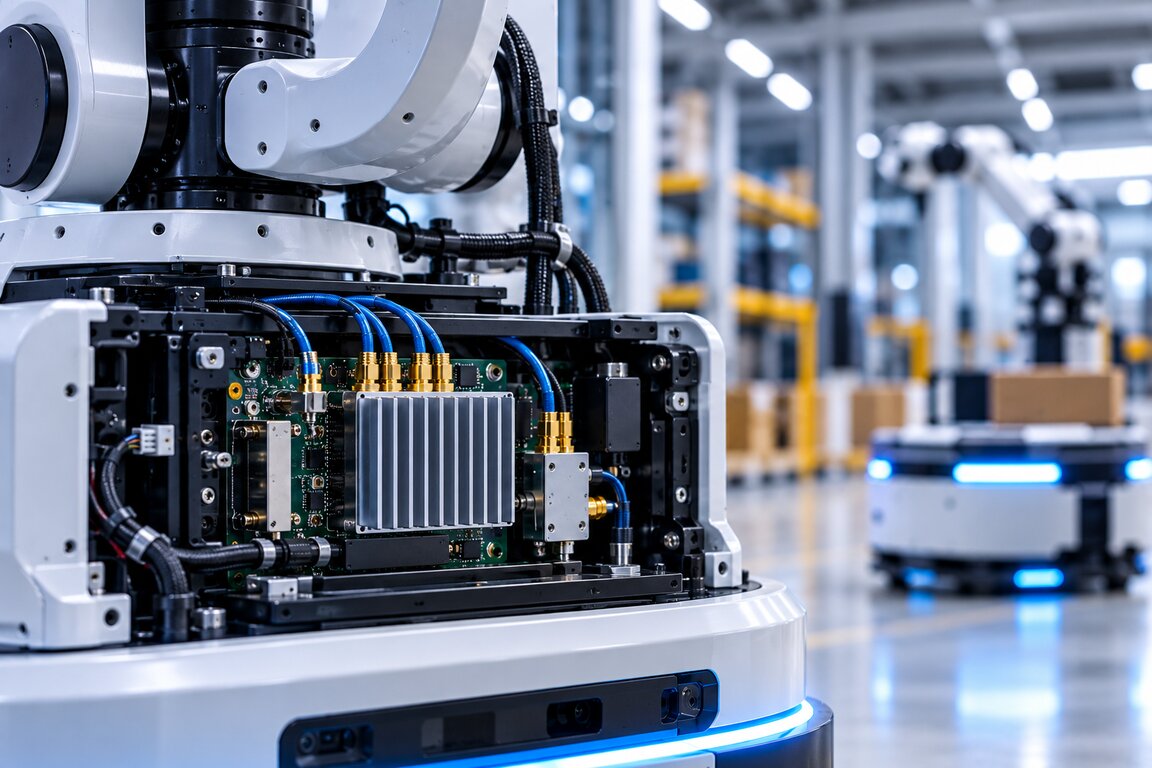
5. Edge AI Is Moving Real-Time Processing Closer to the Robot
Cloud computing remains important to industrial automation, but not every robotic decision can wait for information to travel to a remote server and back. That is driving greater adoption of edge AI, where data processing occurs directly on or near the robotic platform. A robot can analyze camera feeds, navigation information and sensor inputs locally and respond almost immediately to changing conditions.
The RF connectivity challenge
Edge processing places additional electronics inside the robot. Sensors, cameras, processors, antennas and wireless modules must all be connected within a compact architecture. Engineers therefore need short, reliable and space-efficient RF signal paths capable of supporting increasingly sophisticated electronics.
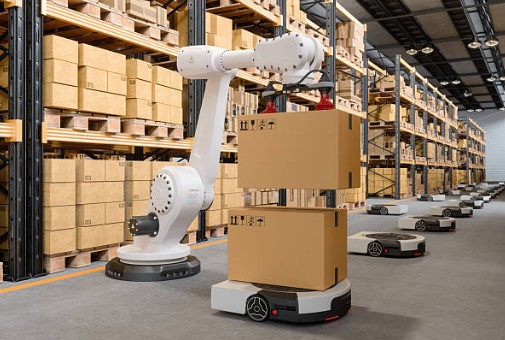
6. Robot Fleets Are Creating Connected Automation Ecosystems
The future of robotics is not one robot operating independently. Factories and warehouses are increasingly becoming connected automation ecosystems in which autonomous mobile robots, robotic arms, sensors, conveyors, machine vision systems and network infrastructure work together. Fleet management systems can coordinate multiple robots simultaneously, adjusting routes and workloads based on production requirements and real-time operating conditions.
The RF connectivity challenge
Connectivity problems become more consequential as automation scales. A degraded connection may affect not only one robot but also the workflows and equipment that depend on that robot's data. Robot fleets also increase wireless device density, network traffic and the number of antennas, radios and RF connections throughout the facility.
Reliable RF Connectivity Is Becoming Critical to Robotics Design
AI, machine vision, private 5G, miniaturization and edge computing may appear to be separate robotics trends, but each depends on the same underlying capability: moving data reliably between sensors, processors, antennas and networks. As robots become more intelligent and automation systems become increasingly interconnected, RF connectivity must be considered early in the design process.
The appropriate RF interconnect can help engineers address critical requirements including:
-
High-speed data transmission
-
Reliable signal integrity
-
Compact packaging and greater connector density
-
Resistance to vibration and mechanical stress
-
Environmental protection
-
Reliable antenna and wireless network connections
-
Flexible routing within space-constrained robotic platforms
Amphenol RF offers a broad portfolio of standard and custom RF connectors, coaxial cable assemblies and adapters for robotics, including AUTOMATE® Mini-FAKRA, FAKRA, SMA, AMC, MCX, MMCX and N-Type solutions.
From compact sensor connections inside an autonomous robot to wireless infrastructure supporting an entire automation ecosystem, Amphenol RF helps engineers build the reliable RF foundation required for the next generation of robotics.
Explore RF connectivity solutions for robotics or contact Amphenol RF to discuss the requirements of your next robotic design.
给我们留言
请填写下表,我们将尽快与您联系。
标有星号 (*) 的字段为必填字段。